Implementing SNMP in VxWorks: Embedded Network Management for Real-Time Systems
As embedded systems become increasingly networked, remote monitoring and management have evolved from optional features into critical system requirements. Whether deployed in industrial automation, defense systems, telecommunications infrastructure, or radar control platforms, embedded devices must provide visibility into operational status, performance metrics, and fault conditions.
The Simple Network Management Protocol (SNMP) remains one of the most widely adopted standards for network monitoring and device management. While SNMP is commonly associated with enterprise networking equipment, it can also be effectively integrated into resource-constrained embedded systems.
This article explores the design and implementation of a complete SNMP management solution within the VxWorks real-time operating system, including agent services, management stations, MIB processing, trap notifications, network topology discovery, and graphical user interfaces.
🌐 Why SNMP Matters in Embedded Systems #
SNMP provides a standardized framework for monitoring and managing network-connected devices.
The protocol operates using a Manager-Agent architecture:
- Manager: Centralized management station responsible for monitoring and controlling devices.
- Agent: Software running on managed devices that exposes system information and accepts management requests.
This architecture enables administrators to:
- Monitor device status remotely
- Retrieve performance metrics
- Configure system parameters
- Detect failures
- Receive real-time fault notifications
For embedded platforms such as radar monitoring and control systems, these capabilities significantly improve operational efficiency and maintenance responsiveness.
⚙️ Development Environment and Platform Architecture #
VxWorks as the Foundation #
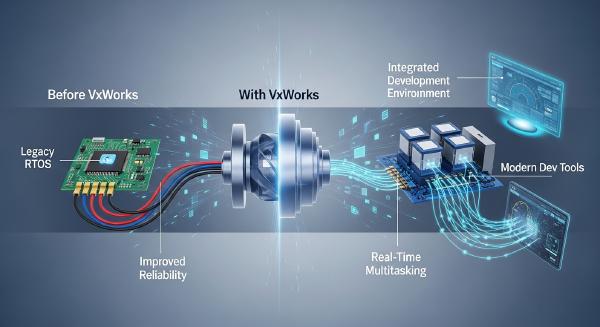
The project was implemented on the VxWorks real-time operating system, selected for its:
- Deterministic scheduling
- Multitasking capabilities
- Networking support
- POSIX compatibility
- Reliability in mission-critical environments
Because of specific security and project requirements, the implementation did not rely on the complete WindNet management framework. Instead, custom network management components were developed directly within the application layer.
Development Tools #
The software was developed using the Tornado Integrated Development Environment (IDE), which provides:
- Cross-compilation tools
- Debugging utilities
- Simulators
- Build automation
- Remote target management
All SNMP functionality was implemented using C and C++.
Embedded Hardware Platform #
The target architecture consisted of:
- Main control board
- Multiple distributed processing boards
- Ethernet communication interfaces
- Serial communication channels
Development and debugging were performed through Ethernet or serial connectivity between the host workstation and target hardware.
🖥️ Building Embedded GUIs with Zinc #
Traditional embedded management systems often suffer from poor user interfaces due to hardware limitations.
To overcome this challenge, the project utilized Zinc for VxWorks, a lightweight graphical development framework optimized for embedded environments.
Key benefits include:
- Low memory consumption
- Native code generation
- Window-based interface support
- Event-driven programming
- Efficient rendering performance
Unlike earlier embedded GUI approaches, Zinc provided a practical solution for creating modern management interfaces without compromising system resources.
📚 Understanding the SNMP Agent Architecture #
The SNMP agent serves as the interface between the managed device and external management stations.
SNMP operates over UDP and typically uses:
| Service | UDP Port |
|---|---|
| SNMP Agent | 161 |
| SNMP Trap Receiver | 162 |
Each SNMP message contains:
- Protocol version
- Community string
- Request ID
- Protocol Data Unit (PDU)
The agent continuously listens for requests and returns appropriate responses.
🌳 MIB Design and Object Management #
What Is a MIB? #
The Management Information Base (MIB) is a hierarchical collection of managed objects.
Each object is identified by a unique Object Identifier (OID).
Examples include:
| OID | Description |
|---|---|
| 1.3.6.1.2.1.1 | System Group |
| 1.3.6.1.2.1.1.1.0 | sysDescr |
A custom MIB implementation was developed to support:
- OID storage
- Data value management
- Access control
- Data type definitions
- Lexicographical traversal
The latter is particularly important for supporting GetNext operations.
MIB Data Structure Requirements #
Each managed object contains:
- Object identifier
- Current value
- Data type
- Read/write permissions
- Internal indexing information
Efficient organization of these structures is critical for minimizing lookup times and resource consumption.
🔄 SNMP Agent Processing Workflow #
The agent implementation follows a structured processing pipeline.
1. MIB Initialization #
During startup, the agent:
- Creates the local MIB database
- Allocates memory for managed objects
- Establishes indexing structures
- Sorts OIDs lexicographically
This preparation accelerates request processing.
2. UDP Socket Creation #
The agent opens a UDP socket and binds to port 161.
Incoming packets are monitored using the VxWorks select() API, enabling efficient event-driven processing.
3. ASN.1 Packet Parsing #
SNMP messages are encoded using ASN.1.
The agent performs:
- Message decoding
- Version verification
- Community validation
- PDU extraction
- OID identification
Invalid requests are rejected before reaching the processing stage.
4. Request Execution #
Supported operations include:
- Get
- Set
- GetNext
Each request triggers corresponding MIB operations and generates result data.
5. Response Generation #
After processing:
- A response PDU is created
- ASN.1 encoding is applied
- The packet is transmitted back to the manager
This completes the request-response cycle.
Example Agent Implementation #
The following simplified example illustrates the overall structure of an SNMP agent under VxWorks:
#include "vxWorks.h"
#include "sockLib.h"
#include "selectLib.h"

int my_agent(void)
{
    init_mib(my_mib);

    snmpsock = socket(PF_INET, SOCK_DGRAM, 0);

    bind(
        snmpsock,
        (struct sockaddr *)&clientAddr,
        sizeof(clientAddr)
    );

    while (1)
    {
        ret = select(width, &fd, NULL, NULL, NULL);

        if (FD_ISSET(snmpsock, &fd))
        {
            recvfrom(
                snmpsock,
                pdubuf,
                len_buf,
                0,
                &from,
                &len_addr
            );

            parse_pdu(
                &request_pdu,
                pdubuf,
                len
            );

            get_oid(&request_pdu);

            process_request(&request_pdu);

            create_pdu(
                &request_pdu,
                pdubuf,
                PDU_RESP
            );

            sendto(
                snmpsock,
                pdubuf,
                len,
                0,
                &ManagerAddr,
                len_addr
            );
        }
    }

    close_agent(snmpsock);
}
🚨 Trap Notifications for Proactive Monitoring #
Polling alone is often insufficient for real-time fault management.
SNMP Traps allow agents to proactively notify management stations when significant events occur.
Common trigger conditions include:
- Interface failures
- System restarts
- Hardware faults
- Service interruptions
- Recovery events
This mechanism reduces management traffic while improving responsiveness.
Trap Generation Example #
int my_trap(void)
{
    init_mib(my_trap_mib);

    create_trap(
        &trap_pdu,
        pdubuf,
        PDU_TRAP
    );

    trapsock = socket(
        PF_INET,
        SOCK_DGRAM,
        0
    );

    sendto(
        trapsock,
        pdubuf,
        len_pdu,
        0,
        &ManagerAddr,
        len_addr
    );

    close_trap(trapsock);
}
🖧 Implementing the SNMP Manager #
The management station functions as the centralized control entity.
Its responsibilities include:
- Sending requests
- Receiving responses
- Processing trap notifications
- Maintaining target configurations
- Displaying network status
Request and Response Processing #
The manager generates:
- GetRequest
- GetNextRequest
- SetRequest
Because SNMP uses UDP, reliability mechanisms must be implemented at the application layer.
These include:
- Timeout detection
- Retransmission handling
- Response validation
- Error reporting
This ensures robust communication despite UDP’s connectionless nature.
Trap Reception #
The manager continuously listens on UDP port 162.
Incoming trap messages are:
- Parsed
- Categorized
- Timestamped
- Logged for operator review
This creates a centralized event history for fault analysis.
🔍 Network Topology Discovery Using ICMP #
One of the most useful management features is automatic network discovery.
The implementation combines:
- SNMP information gathering
- ICMP Echo requests (Ping)
The discovery process identifies:
- Reachable devices
- Network addresses
- Device types
- Connectivity relationships
- Interface status
This approach is particularly effective in relatively small embedded networks such as radar control environments.
The resulting topology information is presented graphically to operators.
🖼️ Designing the Management Interface #
The Zinc-based management station provides a multi-window graphical interface that simplifies system administration.
MIB Browser #
The MIB Browser allows operators to:
- Navigate OID hierarchies
- Execute Get operations
- Execute GetNext operations
- Modify writable values using Set commands
This functionality mirrors traditional enterprise SNMP management platforms.
Target Management #
The target management module maintains:
- Device IP addresses
- Community strings
- Timeout values
- Retry policies
Centralized configuration simplifies large-scale monitoring.
Network Topology View #
A graphical topology display provides:
- Device visualization
- Connection mapping
- Reachability indicators
- Operational status information
This allows operators to quickly assess network health.
Fault Log #
Trap events are recorded in a dedicated troubleshooting module.
Captured information includes:
- Timestamp
- Event source
- Event type
- Detailed descriptions
Historical logs assist with diagnostics and maintenance planning.
Example GUI Event Handler #
The following simplified Zinc callback demonstrates how SNMP operations can be integrated into the user interface:
ZafEventType func_get(
    ZafWindowObject *object,
    ZafEventStruct &,
    ZafEventType ccode
)
{
    my_manager();

    if (myvalue_type == ASN1_OCTSTR)
    {
        save_value(...);

        Pdu_Field->SetText(
            output_value
        );
    }

    return ccode;
}
⚡ Benefits of SNMP Integration in VxWorks #
The completed solution delivered several significant advantages.
Centralized Monitoring #
Administrators gained visibility into device health, status, and operational metrics from a single management platform.
Improved Fault Detection #
Trap-based notifications enabled rapid identification of failures and abnormal conditions.
Reduced Operational Complexity #
Graphical management tools simplified device administration and troubleshooting.
Efficient Resource Utilization #
The implementation maintained a small footprint suitable for embedded hardware while preserving real-time performance.
Scalability #
The architecture can be extended to support:
- Additional managed devices
- New MIB modules
- Larger network environments
- Future protocol enhancements
🎯 Conclusion #
Implementing SNMP within a VxWorks-based embedded environment demonstrates that enterprise-grade network management capabilities can be successfully adapted for real-time systems. By combining a custom SNMP agent, a feature-rich management station, ICMP-based topology discovery, and a lightweight Zinc graphical interface, the solution delivers comprehensive monitoring and control without compromising performance.
The project highlights the flexibility of VxWorks as a platform for embedded networking applications and provides a practical blueprint for engineers developing network management capabilities in mission-critical systems.
As embedded devices become increasingly interconnected, future enhancements such as SNMPv3 security, advanced MIB support, automated diagnostics, and integration with higher-level management platforms will further strengthen the role of SNMP in modern embedded architectures.