VxWorks 7 on T2080: BSP, U-Boot, and Kernel Adaptation Guide
🔍 Overview #
VxWorks is a production-grade RTOS widely used in aerospace, defense, and industrial systems where deterministic performance is critical. VxWorks 7 introduces a modular architecture, Device Tree support, and an updated driver framework (VxBus GEN2), significantly improving portability and maintainability.
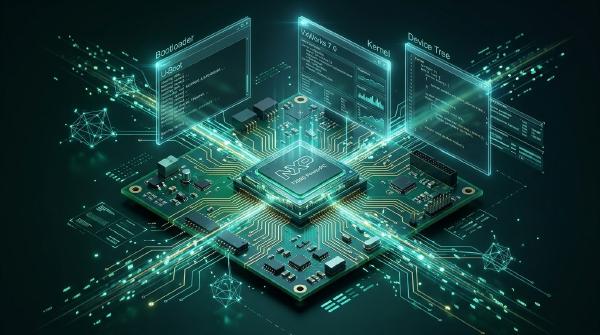
This guide walks through the full adaptation of VxWorks 7 on the NXP T2080 processor, including U-Boot porting, BSP development, kernel configuration, Device Tree integration, and driver implementation—with practical code examples.
⚙️ T2080 Platform and System Context #
The T2080 is a QorIQ-series PowerPC SoC with:
- Quad-core, 8-thread architecture
- High-performance SIMD (AltiVec) engine
- Designed for networking, radar, and signal processing workloads
Its architecture makes it a strong candidate for high-throughput RTOS deployments.
🚀 Bootloader Development with U-Boot #
Bootloader Responsibilities #
The bootloader initializes hardware and loads the kernel:
- DDR and clock initialization
- MMU setup
- Peripheral initialization
- Kernel loading (Flash, eMMC, or network)
VxWorks 7 standardizes on U-Boot, replacing legacy bootrom.
🧩 U-Boot Board Configuration Example #
A custom board is typically derived from a reference design (e.g., t208xrdb).
Board Header Configuration (include/configs/t208xleihua.h)
#
#ifndef __T208X_LEIHUA_H
#define __T208X_LEIHUA_H

#define CONFIG_SYS_SDRAM_SIZE   (2 * 1024 * 1024 * 1024ULL) /* 2GB DDR */
#define CONFIG_SYS_INIT_RAM_ADDR 0xfdd00000
#define CONFIG_SYS_INIT_RAM_SIZE 0x00004000

#define CONFIG_HOSTNAME         "t2080_leihua"
#define CONFIG_BOOTCOMMAND      "bootm 0x1000000 - 0x2000000"

#define CONFIG_PHY_ADDR         0x1
#define CONFIG_NETMASK          255.255.255.0
#define CONFIG_IPADDR           192.168.1.100

#endif
🔄 U-Boot Initialization Snippet #
Early Boot Entry (start.S excerpt)
#
.globl _start
_start:
    bl  cpu_init_f        /* early CPU init */
    bl  board_init_f      /* board-specific init */
    bl  relocate_code     /* relocate to DDR */
🛠️ Build Example #
export CROSS_COMPILE=powerpc-linux-gnuspe-
make T2080RDB_defconfig
make -j8
🧠 VxWorks 7 Kernel and BSP Development #
VSB and VIP Workflow #
VxWorks 7 separates build stages:
- VSB: builds core OS libraries
- VIP: assembles final image and integrates BSP + DTS
⚙️ VIP Kernel Configuration Example #
Within Workbench or CLI:
vxprj vip create -force -vsb my_vsb -bsp t2080
cd my_vip
vxprj component add INCLUDE_NET_STACK
vxprj component add INCLUDE_IPCOM
vxprj build
🌳 Device Tree Integration #
DTS Example for T2080 Board #
/ {
    model = "T2080 Leihua Board";
    compatible = "fsl,t2080";

    memory {
        device_type = "memory";
        reg = <0x0 0x80000000>; /* 2GB */
    };

    soc {
        ethernet@24000 {
            compatible = "fsl,t2080-gemac";
            reg = <0x24000 0x1000>;
            phy-handle = <&phy0>;
        };

        phy0: ethernet-phy@1 {
            reg = <1>;
        };
    };
};
Compile Device Tree #
dtc -I dts -O dtb -o t2080.dtb t2080.dtsLoad DTB in U-Boot #
tftp 0x1000000 vxWorks.bin
tftp 0x2000000 t2080.dtb
bootm 0x1000000 - 0x2000000
🔌 Driver Development with VxBus GEN2 #
Basic Driver Skeleton #
Driver Registration #
LOCAL VXB_DRV myDrv;

LOCAL STATUS myDrvProbe(VXB_DEV_ID pDev)
{
    return OK;
}

LOCAL STATUS myDrvAttach(VXB_DEV_ID pDev)
{
    printf("My driver attached\n");
    return OK;
}

VXB_DRV myDrv = {
    {NULL},
    "myDevice",
    "My Custom Driver",
    VXB_BUSID_FDT,
    0,
    0,
    myDrvProbe,
    myDrvAttach,
    NULL
};

VXB_DRV_DEF(myDrv)
Device Tree Binding Example #
mydevice@30000 {
    compatible = "leihua,mydevice";
    reg = <0x30000 0x1000>;
};
Matching Table #
LOCAL const VXB_FDT_DEV_MATCH_ENTRY myMatch[] = {
    { "leihua,mydevice", NULL },
    { NULL }
};
DKM Build Example #
CPU = PPC32
TOOL = gnu

OBJS = myDriver.o

all:
    $(CC) -c myDriver.c
    $(LD) -r -o myDriver.out $(OBJS)
🔧 Custom Hardware Example (SRIO Concept) #
For shared-register hardware like SRIO:
- Represent as a single device node
- Expose multiple logical ports
- Handle resource sharing in driver
✅ Conclusion #
Porting VxWorks 7 to the T2080 platform involves coordinated development across bootloader, BSP, kernel, Device Tree, and drivers.
Key takeaways:
- U-Boot simplifies early-stage bring-up
- Device Tree enables flexible hardware abstraction
- VxBus GEN2 improves driver portability
- VSB/VIP split enhances build modularity
This workflow provides a reusable reference for adapting VxWorks 7 to other PowerPC-based embedded systems requiring high-performance real-time capabilities.
Reference: VxWorks 7 on T2080: BSP, U-Boot, and Kernel Adaptation Guide