Aptiv Highlights VxWorks Role in Artemis II Astronaut Safety
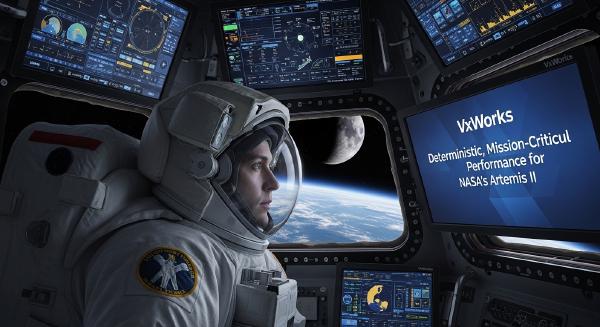
Aptiv has highlighted the role of its VxWorks real-time operating system (RTOS) and safety-critical software technologies in NASA’s successful Artemis II lunar mission, which returned four astronauts safely to Earth.
The company contributed software infrastructure used for critical functions on the first stage of NASA’s Space Launch System (SLS) and within the Orion crew vehicle. VxWorks provided a deterministic execution environment for mission-critical workloads where predictable timing and reliable operation are fundamental requirements.
Aptiv’s involvement also extended beyond the flight software itself. The company used a digital-twin simulation environment to validate software against virtualized representations of the target hardware, allowing development and verification to proceed independently of physical hardware availability.
🚀 VxWorks Supports Mission-Critical Artemis II Functions #
VxWorks is a real-time operating system designed for systems that require deterministic behavior, reliability, and stringent safety requirements. Its use spans aerospace, defense, automotive, and other mission-critical environments.
For Artemis II, Aptiv deployed VxWorks as part of the software platform supporting critical functions on the SLS first stage and within the Orion spacecraft. The deterministic characteristics of an RTOS are particularly important in flight systems, where software must respond to sensor inputs, control operations, and other time-sensitive events within defined execution constraints.
VxWorks also has a long history within NASA programs. The operating system has been used in missions and spacecraft systems including Mars rovers and the James Webb Space Telescope, as well as in elements associated with NASA’s core Flight System architecture.
🛡️ Orion Backup Flight System Adds Independent Safety Layer #
Aptiv identified the Orion Backup Flight System (BFS) as an important component of the spacecraft’s astronaut-safety architecture.
The BFS is designed as a Class A flight system and operates independently from the primary flight system. Its architecture was intentionally differentiated to reduce the possibility of common failure modes and shared vulnerabilities.
This type of architectural independence is particularly important in human-rated spacecraft. A backup system provides greater resilience when its hardware, software architecture, and failure characteristics are sufficiently separated from those of the primary system.
Rather than simply duplicating the same implementation, architectural diversity can help prevent a single design defect or common software failure from affecting both primary and backup systems simultaneously.
🧪 Digital Twins Accelerate Flight Software Validation #
Aptiv also used digital-twin simulation technology to validate flight software before deployment to physical hardware.
The approach allowed engineering teams to execute unmodified target software against a virtual representation of the target platform. This effectively decoupled portions of software development and verification from the availability of physical flight hardware.
For safety-critical aerospace software, this provides several advantages:
- Earlier software validation before physical hardware is available
- Repeatable testing against controlled virtual environments
- Faster identification of software defects and integration issues
- Reduced dependency on hardware-in-the-loop testing during early development
- Greater flexibility for regression testing and mission-specific scenarios
Aptiv said that as much as 80–90% of its simulation models can potentially be reused for future missions. Reusable simulation assets can reduce the engineering effort required to establish comparable verification environments across subsequent spacecraft and flight programs.
🛰️ Software Reliability Remains Central to Human Spaceflight #
Artemis II demonstrates the increasingly important role of software architecture and verification in modern human spaceflight. Flight computers, RTOS platforms, backup systems, and simulation environments must work together under strict timing, reliability, and safety constraints.
For Aptiv, the mission also illustrates how technologies developed for mission-critical software can support increasingly complex spacecraft architectures. VxWorks provides the underlying deterministic execution environment, while independent backup architectures and digital-twin validation add additional layers of resilience and verification.
The successful return of the Artemis II crew underscores the importance of treating flight software as a core component of spacecraft safety rather than simply an enabling technology. In human-rated missions, predictable software behavior, architectural independence, and rigorous validation are integral to the overall reliability of the vehicle.