VxWorks: From 5.5 Legacy to the Future of Real-Time Systems
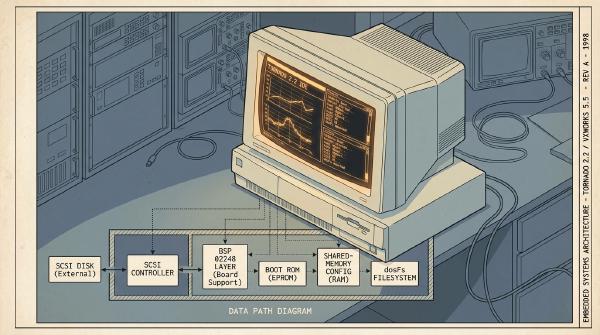
VxWorks 5.5 represents an important chapter in the history of real-time operating systems. Released by Wind River in 2002, the platform went on to support critical embedded applications for more than 16 years before reaching its official End-of-Life (EOL) milestone on July 1, 2018.
That unusually long lifecycle illustrates both the durability expected from industrial RTOS platforms and the challenges of transitioning long-lived embedded systems to newer software architectures.
For customers running safety-critical, aerospace, infrastructure, and autonomous systems, replacing an RTOS is rarely a simple software upgrade. It can involve hardware dependencies, certification requirements, application compatibility, development tools, testing procedures, and years of accumulated engineering knowledge.
The retirement of VxWorks 5.5 therefore marked more than the end of an individual product release. It provided an opportunity to examine how Wind River’s real-time technology had evolved—and where VxWorks was heading next.
🕰️ Looking Back at VxWorks 5.5 #
VxWorks 5.5 was introduced during a very different era of embedded computing.
The early 2000s saw the rapid expansion of mobile devices, connected electronics, and increasingly sophisticated embedded systems. At the same time, industries such as aerospace, defense, transportation, and industrial control required operating systems capable of providing predictable and reliable real-time behavior.
VxWorks 5.5 became a long-lived platform in that environment.
For its customers, the value of the platform was not simply its feature set. Long-term support was particularly important for embedded products whose development, qualification, deployment, and operational lifetimes could extend across many years.
During its lifecycle, VxWorks 5.5 customers received ongoing product support, defect fixes, security updates, and technical assistance from Wind River.
With an average product lifecycle of roughly five years cited at the time, the 16-year lifespan of VxWorks 5.5 was more than three times that benchmark.
🔒 Long-Term Support Matters in Embedded Systems #
A conventional desktop or mobile software product can often be replaced relatively quickly. Mission-critical embedded software is different.
An RTOS can become deeply integrated into:
- Hardware abstraction layers
- Device drivers
- Board-support packages
- Application software
- Networking stacks
- Development toolchains
- Testing infrastructure
- Safety and security processes
- Product certification workflows
Consequently, an operating-system migration can become a major engineering project.
For customers operating products in the field, continued maintenance is particularly valuable because software defects and security vulnerabilities can remain relevant long after the original product launch.
The VxWorks 5.5 lifecycle demonstrates why software longevity is an important engineering consideration for embedded systems, particularly when hardware and software are expected to remain operational for decades.
🚀 VxWorks and the Mars Exploration Rover #
One of the most prominent examples associated with Wind River technology is NASA’s Mars Exploration Rover program.
NASA’s Jet Propulsion Laboratory (JPL) used Wind River technology for the Mars rovers, where real-time software had to support mission-critical operations in an exceptionally constrained environment.
The rover’s software was responsible for functions including:
- Trajectory operations
- Descent and landing activities
- Ground operations
- Scientific data collection
- Mars-to-Earth communications
- Mission-control interactions
These workloads illustrate the type of environment in which deterministic and reliable real-time software becomes essential.
On Mars, software failures cannot be resolved through conventional maintenance procedures. Communication delays, limited computing resources, and the inability to physically service the vehicle make software reliability a fundamental part of mission design.
The rover program therefore became a notable example of how embedded real-time technology can support systems operating far beyond conventional terrestrial environments.
📅 VxWorks 5.5 Reaches End of Life #
After 16 years of service, VxWorks 5.5 officially reached End of Life on July 1, 2018, in accordance with Wind River’s product lifecycle policy.
EOL does not necessarily mean that every existing device immediately stops functioning. Instead, it marks the end of the vendor’s standard lifecycle commitment for that particular product release.
For organizations still dependent on the platform, the transition creates several possible paths.
Customers can evaluate specialized EOL support arrangements where available, maintain existing deployments under their own risk-management processes, or begin migration toward a newer VxWorks release.
For long-lived embedded products, the decision is often influenced by more than software features. Certification, hardware compatibility, application portability, development-tool support, security requirements, and the remaining commercial lifetime of the product all need to be considered.
🔄 Looking Forward: The Evolution of VxWorks #
The retirement of VxWorks 5.5 did not represent the end of the VxWorks platform.
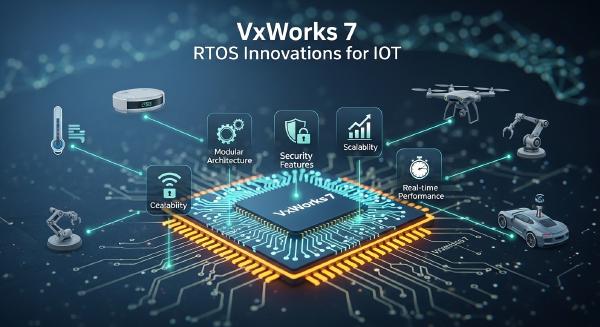
Wind River continued evolving VxWorks for newer generations of embedded and real-time applications, expanding its capabilities across safety-critical systems, critical infrastructure, networking, and autonomous devices.
The broader direction reflects a familiar pattern in embedded software: preserve the deterministic behavior and reliability required by real-time workloads while incorporating newer networking, security, multicore, development, and application technologies.
At the time discussed in the original article, VxWorks 7 SR0540 represented one stage of that evolution.
Among its highlighted capabilities were updates to the Real-Time Network Stack (RTNET), including IP multicast support, security improvements involving the OpenSSL FIPS 140-2 module, SSH server enhancements, and support for Open Source Computer Vision (OpenCV).
These additions demonstrate how a modern RTOS increasingly has to address both traditional real-time requirements and the software capabilities expected from connected computing platforms.
🌐 From Deterministic RTOS to Connected Embedded Platform #
Modern embedded systems increasingly combine real-time control with networking, security, computer vision, cloud connectivity, and autonomous decision-making.
That changes the role of an RTOS.
A real-time operating system may need to coordinate:
- Deterministic execution for time-sensitive workloads.
- Networking for communication with other systems and infrastructure.
- Security for protecting software, devices, and data.
- Hardware acceleration for increasingly complex workloads.
- Computer vision and AI workloads in autonomous devices.
- Safety mechanisms for systems where failures can have significant consequences.
- Developer tooling capable of supporting increasingly complex software stacks.
The challenge is balancing these capabilities without compromising the predictable execution behavior that makes an RTOS suitable for critical applications.
🧩 Why Legacy RTOS Migration Is Difficult #
Moving from an older VxWorks release to a modern platform can involve considerably more work than changing a version number.
A typical migration may require engineers to review:
- Legacy APIs and application dependencies
- BSP and driver compatibility
- Processor and board support
- Network-stack integration
- Storage and filesystem behavior
- Build systems and development tools
- Timing assumptions
- Interrupt handling
- Multithreaded behavior
- Security requirements
- Testing and verification procedures
- Certification evidence
For safety-critical applications, the certification implications can be particularly significant.
This is why long-lived RTOS products can remain in production long after newer versions have become available. The cost and risk of migration must be balanced against the benefits of adopting newer software.
🛡️ Safety, Security, and Reliability as Core Requirements #
The evolution of VxWorks also reflects the convergence of three major requirements in modern embedded software: real-time determinism, safety, and security.
Traditional embedded applications often focused primarily on predictable execution and hardware control. Modern connected devices introduce additional attack surfaces through networking, remote management, third-party libraries, and increasingly complex software stacks.
An RTOS used in critical infrastructure or autonomous equipment therefore needs to address both timing behavior and cybersecurity.
Security updates, cryptographic modules, secure communications, vulnerability management, and controlled software lifecycles have become integral parts of the embedded development process.
For safety-critical systems, these requirements coexist with verification and certification constraints, making the underlying software platform an important part of the overall system architecture.
🧑💻 The Broader VxWorks Ecosystem #
VxWorks ultimately serves as more than a kernel or runtime component.
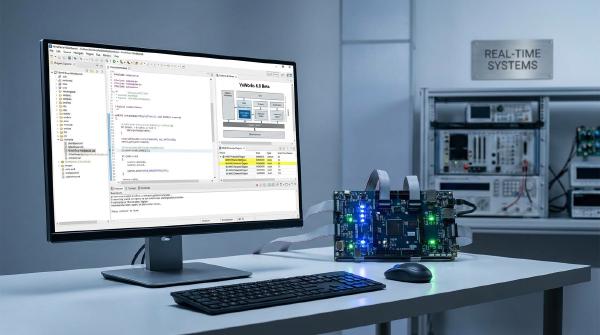
For embedded developers, an RTOS platform typically forms a software foundation connecting hardware, middleware, application code, networking, security, debugging, and deployment.
This makes the surrounding ecosystem just as important as individual kernel features.
A successful embedded platform must provide a practical path from:
Hardware → BSP → RTOS → Drivers → Middleware → Applications → Testing → Deployment
Changes at any layer can affect the entire product.
That is one reason established RTOS platforms can remain valuable over long periods: customers are not merely choosing an operating system; they are investing in a complete development and maintenance environment.
🔭 The Future of VxWorks #
The long-term evolution of VxWorks follows a broader trend in embedded computing.
Future real-time systems increasingly need to combine deterministic execution with capabilities traditionally associated with general-purpose operating systems, including advanced networking, security, computer vision, multicore processing, and support for increasingly sophisticated autonomous applications.
At the same time, safety-critical products continue to demand predictable behavior, controlled software lifecycles, and rigorous engineering processes.
The challenge for an RTOS is therefore not simply to add more features. It is to integrate those capabilities while preserving the reliability and determinism expected from the platform.
📌 Conclusion #
VxWorks 5.5’s 16-year lifecycle is a useful case study in the longevity of mission-critical embedded software.
Its retirement in 2018 closed the chapter on a platform that had supported generations of products and projects, including highly visible aerospace applications such as NASA’s Mars Exploration Rover program.
But the more important story is what happened after the legacy release.
VxWorks continued evolving toward modern embedded requirements, incorporating improvements in networking, security, computer vision, and software-platform capabilities while retaining its focus on real-time and critical systems.
For embedded engineers, the VxWorks 5.5 story highlights a fundamental reality of industrial software: a successful RTOS is measured not only by its performance today, but also by how reliably its ecosystem can evolve over the lifetime of the systems that depend on it.