
Implementing SNMP on VxWorks for Embedded Network Management
Simple Network Management Protocol (SNMP) remains one of the most widely used standards for monitoring and managing networked devices. Although the protocol originated in traditional IT environments, it is equally valuable in embedded systems such as telecommunications equipment, industrial controllers, and network infrastructure devices.
Implementing SNMP on a real-time operating system like VxWorks presents unique challenges. Embedded platforms typically operate under strict memory, CPU, and reliability constraints, making a lightweight and deterministic design essential.
This article examines a practical SNMP implementation on VxWorks, covering Agent and Manager architecture, MIB organization, Trap handling, network discovery, and graphical management tools built with Wind River technologies.
🚀 Why SNMP Matters in Embedded Systems #
SNMP provides a standardized mechanism for:
-
Monitoring device status
-
Collecting operational metrics
-
Configuring parameters remotely
-
Reporting faults and alarms
-
Integrating devices into centralized management systems
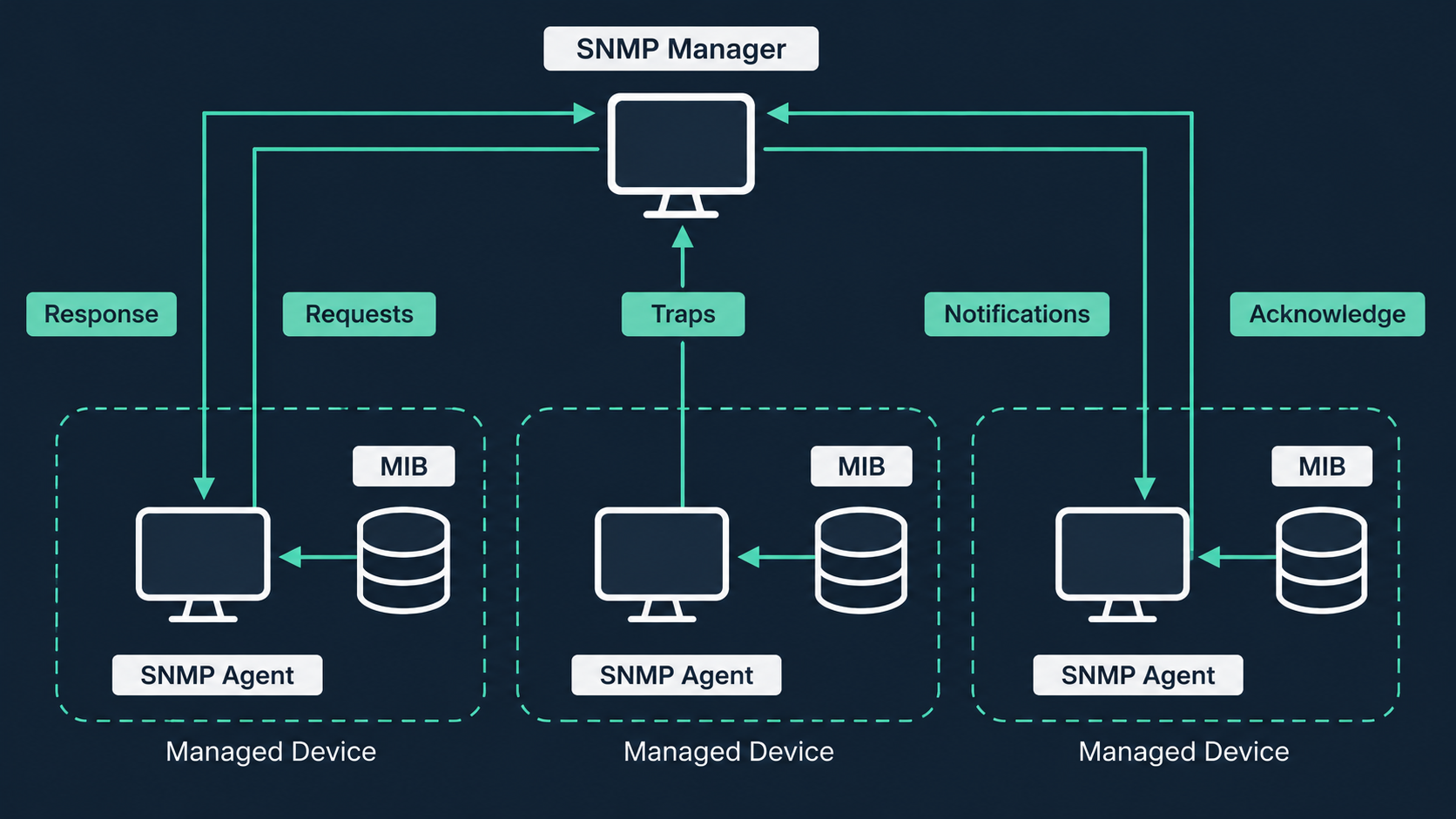
The protocol follows the classic Manager-Agent model:
-
The Manager (Network Management Station, or NMS) initiates requests.
-
The Agent runs on the managed device and exposes management data.
-
Managed information is stored in a hierarchical database called the Management Information Base (MIB).
For embedded devices with limited local user interfaces, SNMP offers a highly efficient method for remote administration.
🛠️ Development Environment #
The implementation was built using Wind River’s embedded development ecosystem.
Operating System #
The target platform was VxWorks, chosen for its:
-
Deterministic real-time behavior
-
Multitasking support
-
POSIX compatibility
-
Robust networking stack
-
Flexible I/O architecture
Development Tools #
The project used:
-
Tornado for cross-development in C/C++
-
Zinc for the graphical management interface
Because the full WindNet networking module was not adopted for security reasons, several networking components were implemented specifically for the project.
🌐 SNMP Protocol Basics #
SNMP uses a lightweight request-response model over UDP.
Default Ports
| Function | UDP Port |
|---|---|
| SNMP Agent requests | 161 |
| SNMP Trap notifications | 162 |
Typical Message Structure
-
SNMP version
-
Community string
-
Protocol Data Unit (PDU)
Supported Operations
-
Get – Read a specific MIB object.
-
Set – Modify a writable MIB object.
-
GetNext – Traverse the MIB tree sequentially.
-
Trap – Asynchronous event notification from Agent to Manager.
⚙️ SNMP Agent Architecture #
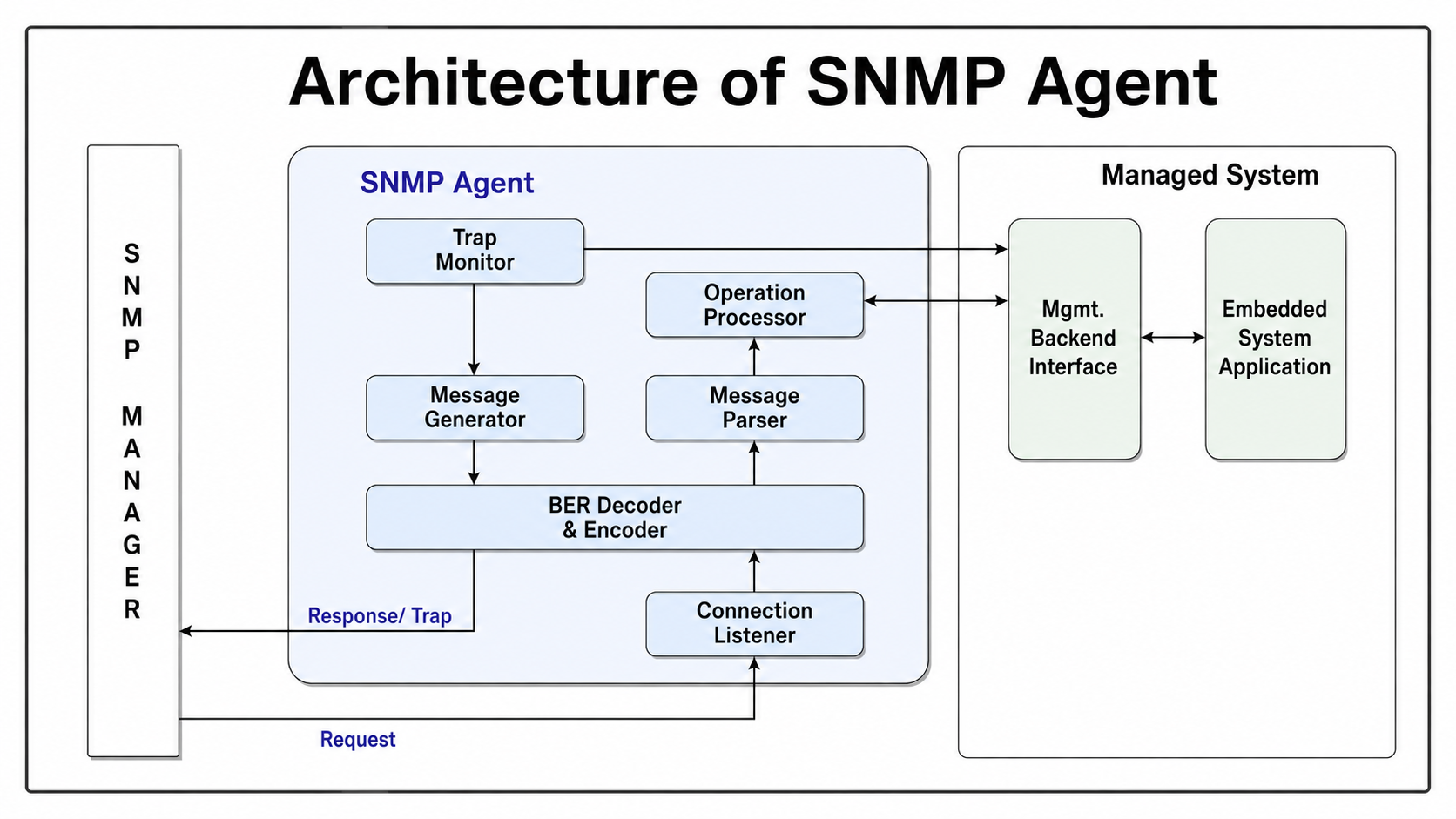
The Agent runs on the embedded device and is responsible for processing management requests.
Agent Responsibilities #
The Agent performs the following sequence:
-
Receive ASN.1-encoded SNMP messages.
-
Validate the community string.
-
Decode the PDU.
-
Locate the requested object in the MIB tree.
-
Execute Get, Set, or GetNext logic.
-
Build and transmit a response PDU.
-
Generate Trap notifications when required.
MIB Organization #
The MIB is implemented as a hierarchical tree of managed objects.
Each entry contains information such as:
-
Object Identifier (OID)
-
Data type
-
Current value
-
Access permissions
-
Traversal information for GetNext operations
To improve lookup performance, the implementation initializes and sorts MIB entries during startup.
🔄 Agent Workflow #
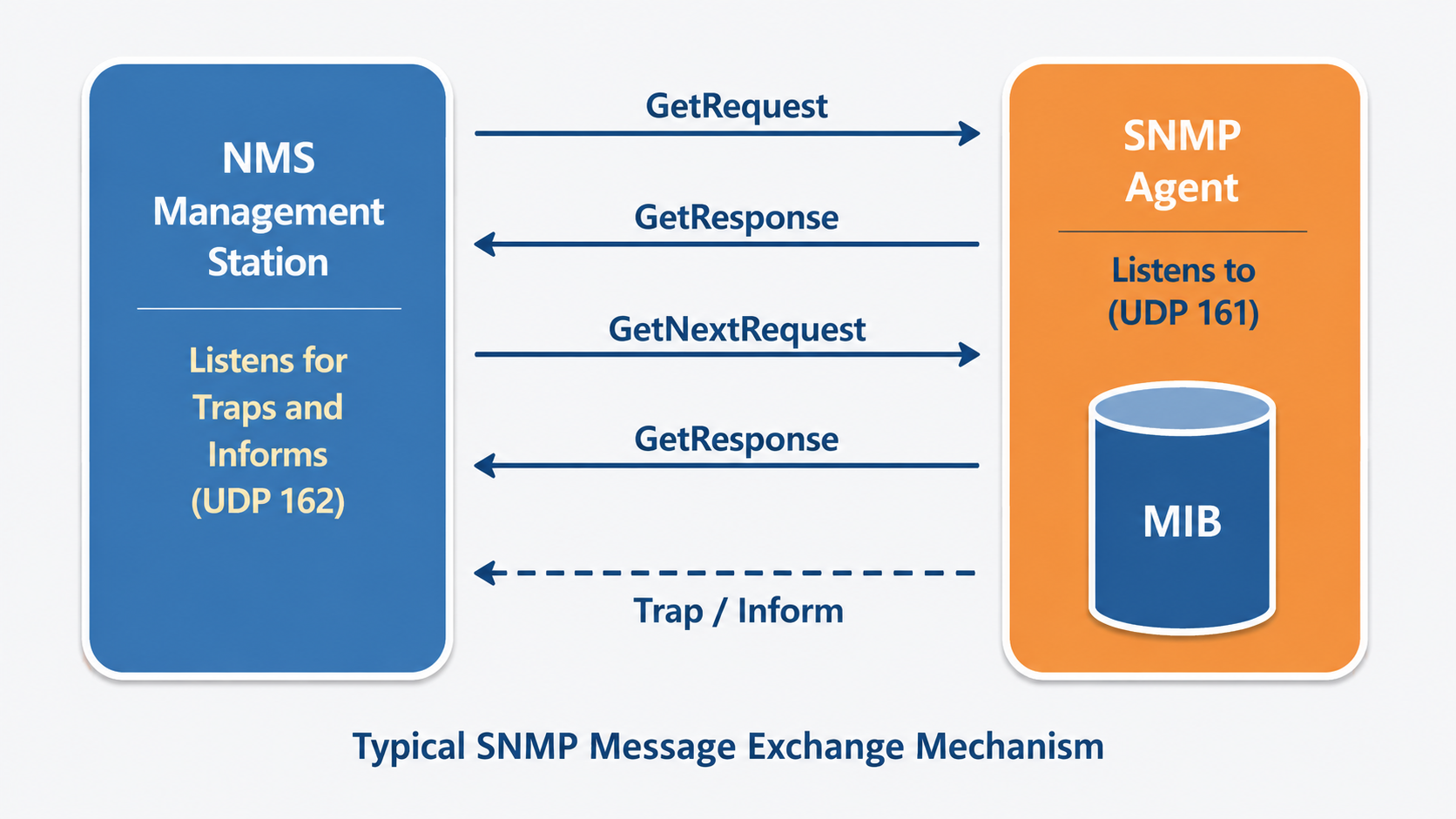
The core Agent task follows a straightforward event-driven model:
Initialization #
-
Build the local MIB table.
-
Create a UDP socket.
-
Bind the socket to port 161.
-
Enter the main processing loop.
Request Processing #
The Agent uses select() to wait for incoming packets without blocking unrelated tasks.
For each received packet:
-
Parse the SNMP header.
-
Verify the community string.
-
Decode the requested OID.
-
Perform Get, Set, or GetNext processing.
-
Encode and send the response.
This design fits well within VxWorks’ multitasking environment and avoids unnecessary CPU consumption.
🚨 Trap Notification Mechanism #
SNMP Traps allow the device to report important events without waiting for a Manager request.
Typical events include:
-
Interface failures
-
System restarts
-
Configuration changes
-
Hardware alarms
-
Threshold violations
A dedicated Trap routine:
-
Builds the Trap PDU.
-
Populates event-specific OIDs.
-
Sends the notification to the Manager on UDP port 162.
This asynchronous mechanism is critical for fault management in telecommunications and industrial systems.
🖥️ SNMP Manager Design #
The Network Management Station acts as the central control point.
Core Functions #
Request/Response Engine
The Manager:
-
Sends Get, Set, and GetNext requests.
-
Implements timeouts and retransmissions.
-
Validates incoming responses.
-
Extracts MIB values for display.
Because SNMP runs over UDP, retransmission logic is essential for reliability.
Trap Receiver
A dedicated listener waits on port 162 and:
-
Parses Trap PDUs.
-
Records alarm information.
-
Updates the management interface.
-
Stores events in a trouble log.
Network Discovery
The implementation combines:
-
ICMP Echo (ping)
-
SNMP queries
to discover:
-
Reachable devices
-
Device types
-
Interface information
-
Network topology relationships
🎨 Graphical Interface with Zinc #
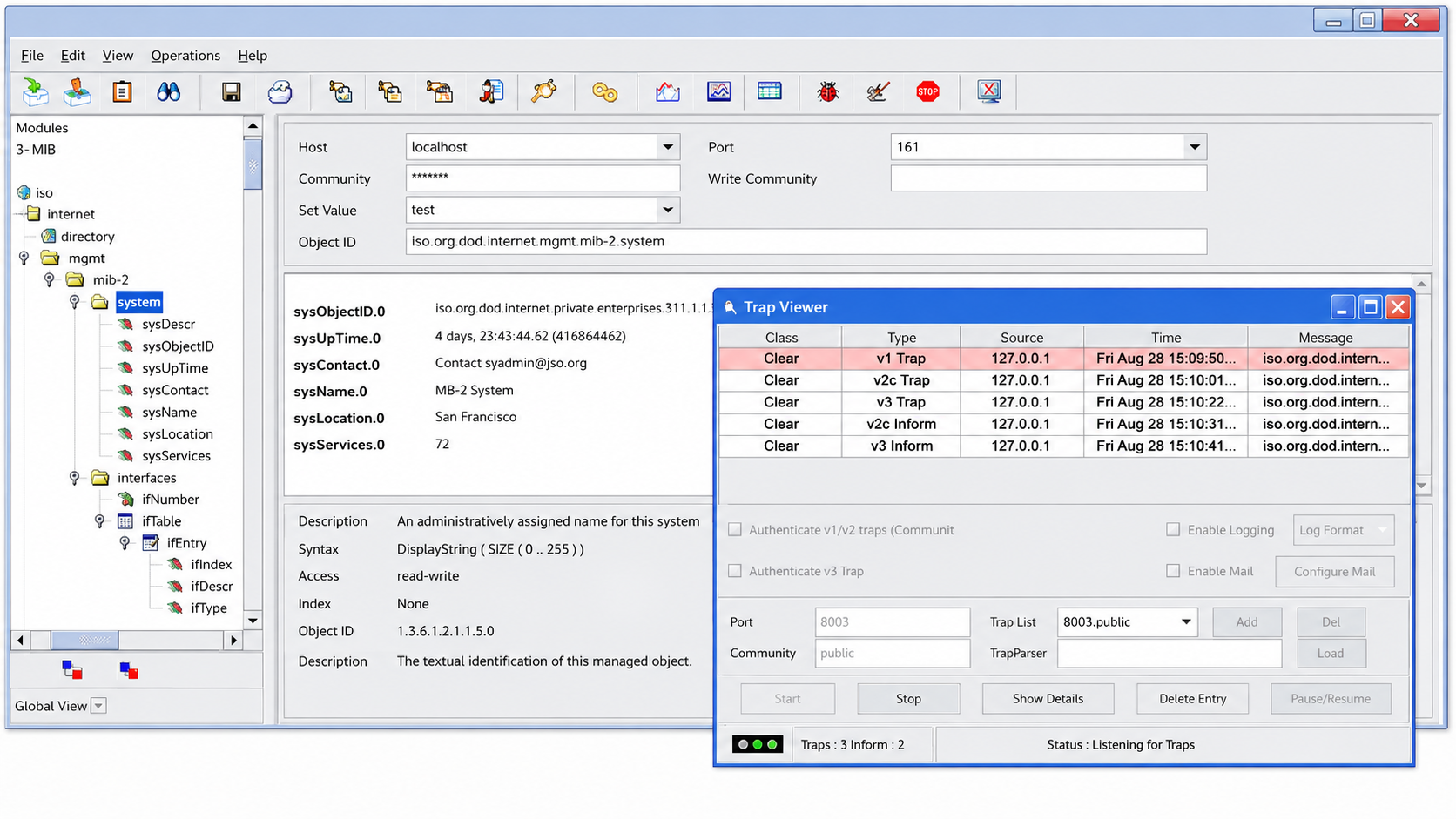
A major feature of the project was a lightweight graphical management interface built with Zinc.
Key Interface Components #
MIB Browser
Allows operators to perform:
-
Get operations
-
GetNext traversal
-
Set operations on writable objects
Target Management
Maintains:
-
Device IP addresses
-
Community strings
-
Timeout values
-
Retransmission policies
Topology View
Displays discovered hosts and their connections graphically.
Trouble Log
Provides persistent storage and display of received Trap events for administrator review.
📈 Advantages of the Implementation #
Compared with a generic SNMP stack, this VxWorks-oriented design offered several benefits.
Real-Time Compatibility #
The Agent uses non-blocking UDP communication and event-driven processing, minimizing interference with higher-priority real-time tasks.
Resource Efficiency #
The lightweight MIB structure and Zinc GUI were designed for systems with limited memory and CPU resources.
Improved Controllability #
Custom networking and management logic provided greater visibility into protocol behavior than some commercial black-box solutions.
Fault Visibility #
Trap handling enabled immediate reporting of critical events without continuous polling from the Manager.
Scalability #
The MIB tree architecture supports incremental addition of new managed objects as system functionality evolves.
🏭 Typical Applications #
This approach is particularly well suited for:
-
Telecommunications base stations
-
Industrial automation controllers
-
Power system equipment
-
Embedded network appliances
-
Defense and aerospace platforms
-
Remote monitoring systems
These environments often require deterministic behavior, low resource consumption, and long-term reliability.
📌 Conclusion #
Implementing SNMP on VxWorks requires more than simply porting a protocol stack. Embedded systems demand careful attention to real-time scheduling, memory usage, network reliability, and fault handling.
By combining VxWorks, Tornado, and Zinc, the project demonstrated a practical architecture for building a complete embedded network management solution that includes:
-
A lightweight SNMP Agent
-
Custom MIB management
-
Trap-based fault reporting
-
Reliable UDP communication
-
ICMP-assisted topology discovery
-
A compact graphical management interface
The result is a network management platform that balances SNMP functionality with the constraints of embedded real-time systems, providing an effective reference for developers building VxWorks-based telecommunications, industrial, and infrastructure equipment.