Siemens SIMATIC IPC VxWorks BSP: PROFIBUS and PROFINET
Siemens SIMATIC IPC VxWorks BSP: PROFIBUS and PROFINET
Siemens SIMATIC Industrial PCs provide hardware interfaces and platform-specific capabilities that are not necessarily supported by a standard VxWorks installation. To bridge this gap, Siemens provides the SIMATIC IPC Support Package for VxWorks, which extends the VxWorks environment with drivers, APIs, and application examples for hardware-specific functions.
The package is particularly relevant for industrial applications that require deterministic real-time execution while also accessing Siemens-specific interfaces such as PROFIBUS and PROFINET.
In addition to industrial communication interfaces, the support package provides access to hardware-dependent functions, such as reading system temperature information. It also includes the development resources required to create customer-specific applications in both kernel mode and Real-Time Process (RTP) mode.
The result is a VxWorks development environment that can take advantage of SIMATIC IPC hardware without requiring developers to implement every platform-specific driver and integration layer from scratch.
🏭 SIMATIC IPC and VxWorks Integration #
VxWorks provides the deterministic real-time operating environment, while the Siemens support package adds the platform-specific functionality required to use SIMATIC IPC hardware effectively.
A standard VxWorks deployment may provide the operating-system services required for real-time application execution, but industrial systems often need additional hardware interfaces that are specific to the target platform.
The SIMATIC IPC Support Package addresses this requirement by providing support for:
- PROFIBUS interfaces
- PROFINET interfaces
- Hardware-dependent functions
- Hardware monitoring
- Platform-specific drivers
- Kernel-mode application development
- RTP-mode application development
- Application examples
- Development-time documentation
- Code-completion support
This creates a layered architecture:
SIMATIC IPC Hardware → VxWorks BSP/Support Package → VxWorks Runtime → Customer Application
The support package effectively acts as the integration layer between Siemens hardware and the VxWorks runtime environment.
⚙️ Supported VxWorks Product Environments #
The Siemens package is designed around Wind River’s Platform for Industrial Devices product line.
Two VxWorks development environments are identified in the provided documentation.
| VxWorks Environment | Runtime System | Development Environment |
|---|---|---|
| Legacy platform | VxWorks Runtime System V6.9, 32-bit | Workbench V3.3 |
| Newer platform | VxWorks Runtime System V7, 32-bit | Workbench V4 |
The exact runtime and Workbench combination depends on the target system and the corresponding Siemens support-package version.
For maintenance projects, this distinction is important because VxWorks 6.9 and VxWorks 7 have significantly different architecture, build, and development workflows.
A legacy SIMATIC IPC deployment may therefore require the older VxWorks 6.9 toolchain, while a newer supported platform can use VxWorks 7 with Workbench 4.
🔌 PROFIBUS and PROFINET Support #
One of the primary reasons for using the Siemens support package is access to industrial communication interfaces.
PROFIBUS integration #
PROFIBUS is a widely deployed industrial fieldbus technology used for communication between controllers, distributed I/O, drives, and other automation components.
For a VxWorks-based SIMATIC IPC, direct access to PROFIBUS hardware allows real-time applications to interact with existing industrial automation infrastructure without relying on an external gateway.
The support package provides the required driver layer and development resources so customer applications can communicate with the supported PROFIBUS hardware through the VxWorks environment.
This is particularly useful for systems where deterministic processing and industrial fieldbus communication must coexist on the same platform.
PROFINET integration #
PROFINET provides industrial Ethernet-based communication and is widely used in modern automation systems.
Compared with traditional fieldbus architectures, PROFINET provides higher bandwidth and greater flexibility for distributed industrial systems.
Supporting PROFINET directly from the SIMATIC IPC’s VxWorks environment allows real-time applications to communicate with industrial controllers, devices, and distributed I/O while maintaining the deterministic execution characteristics of the underlying RTOS.
The combination can be represented as:
VxWorks Application → Siemens Driver Layer → PROFINET Hardware → Industrial Network
This eliminates the need for application developers to build the complete hardware interface stack themselves.
🧩 Hardware-Dependent Functions #
Industrial PCs expose functionality that extends beyond standard CPU and peripheral interfaces.
For example, the SIMATIC IPC Support Package provides access to hardware-dependent functions such as temperature monitoring.
Hardware monitoring can be important in industrial environments because thermal conditions can affect:
- System reliability
- CPU performance
- Component lifetime
- Cooling-system operation
- Fault detection
- Preventive maintenance
Providing these functions through the VxWorks support package allows applications to incorporate platform health information into their own monitoring and control logic.
The application can therefore combine industrial-process data with information about the physical condition of the computing platform.
💻 Kernel Mode and RTP Mode Development #
The support package provides resources for developing applications in both kernel mode and Real-Time Process (RTP) mode.
These execution models provide different levels of access and isolation.
Kernel-mode applications #
Kernel-mode software executes within the privileged operating-system environment.
This model is useful when an application or driver requires direct access to operating-system services or hardware resources.
The trade-off is that kernel-mode code has greater potential to affect system stability because failures can propagate into the operating-system environment.
For hardware drivers and tightly integrated system functionality, however, kernel-level access can be necessary.
Real-Time Processes #
RTPs provide a more isolated execution environment for application software.
This separation can improve software modularity and fault containment while allowing developers to build real-time applications without placing all application logic directly inside the kernel.
The availability of both execution models gives developers flexibility when integrating Siemens hardware functionality into different types of VxWorks applications.
🛠️ Installing the Support Package #
The SIMATIC IPC Support Package for VxWorks is installed on the development computer rather than simply being treated as an application installed on the target system.
This installation provides the development environment with the Siemens-specific components required to build software for the target IPC.
The general workflow is:
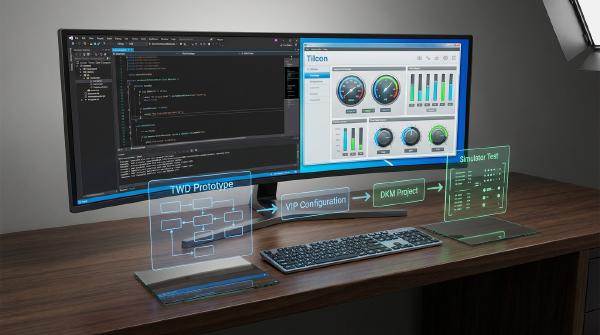
Development Computer → Install Support Package → Configure Project → Build Application → Transfer to Target → Commission SIMATIC IPC
Important platform-specific settings are prepared on the development system before being transferred to the target.
This separation is important in VxWorks development because the development host typically provides the toolchain, project configuration, compilation environment, and support-package resources, while the target IPC provides the actual real-time execution environment.
🚀 Target-System Commissioning #
After the support package has been installed and the development environment configured, the SIMATIC IPC target system can be commissioned.
The development process typically involves several stages:
- Install the appropriate SIMATIC IPC Support Package.
- Select the supported VxWorks runtime environment.
- Configure target-specific hardware settings.
- Configure the required PROFIBUS or PROFINET functionality.
- Build the VxWorks image or application.
- Transfer the required software to the target IPC.
- Start the target system.
- Verify hardware interfaces and platform-specific functions.
- Deploy the customer application.
The exact procedure depends on the VxWorks version, SIMATIC IPC model, and support-package release.
For legacy systems, maintaining the correct combination of VxWorks Runtime System and Wind River Workbench is particularly important.
📚 Development Assistance and Tooling #
The support package is not limited to binary drivers.
It also provides development-oriented resources designed to reduce integration effort.
These include:
- Online help
- Code completion
- Driver documentation
- API information
- Application examples
- Hardware-specific development guidance
Code completion is particularly useful when working with platform-specific APIs because developers can discover available interfaces directly within the development environment rather than manually searching through low-level documentation.
Application examples provide another important advantage.
Instead of beginning with an empty project, developers can use reference implementations to understand how the Siemens-specific interfaces are accessed from VxWorks applications.
🔍 Why a Siemens-Specific BSP Matters #
A Board Support Package or hardware support layer is critical when an RTOS is deployed on industrial hardware with proprietary or platform-specific functionality.
Without a dedicated support layer, developers may need to implement and validate:
- Hardware initialization
- Peripheral access
- Industrial network drivers
- Hardware monitoring
- Interrupt handling
- Device-specific APIs
- Integration with VxWorks services
A vendor-supported BSP and support package significantly reduces that workload.
The SIMATIC IPC Support Package effectively abstracts many of these hardware-specific details so developers can concentrate on the application logic.
The architecture becomes:
Hardware-specific implementation → Siemens support layer → VxWorks services → Application
This separation improves maintainability and makes it easier to reuse application software across supported SIMATIC IPC configurations.
🏗️ Industrial Applications #
The combination of SIMATIC IPC hardware, VxWorks, and Siemens-specific interfaces is well suited to applications that require both deterministic computation and industrial connectivity.
Potential use cases include:
- Industrial controllers
- Motion-control systems
- Machine automation
- Industrial gateways
- Factory monitoring
- Real-time data acquisition
- Distributed control systems
- Industrial communication systems
- Hardware monitoring applications
These systems often require the operating system to satisfy two very different requirements simultaneously.
First, the software must execute predictably under real-time constraints.
Second, it must communicate with industrial equipment using established protocols such as PROFIBUS and PROFINET.
A dedicated support package allows both requirements to be addressed within the same platform.
🔧 Practical Architecture Considerations #
When designing a SIMATIC IPC application around VxWorks, developers should keep several architectural boundaries clear.
Separate platform integration from application logic #
Hardware-specific APIs should ideally be isolated behind well-defined application interfaces.
This prevents customer application code from becoming tightly coupled to a particular SIMATIC IPC implementation.
Select the correct VxWorks generation #
VxWorks 6.9 and VxWorks 7 should not be treated as interchangeable development environments.
The runtime, Workbench version, BSP structure, project configuration, and supported APIs must all match the target platform and Siemens support-package release.
Treat industrial communications as real-time resources #
PROFIBUS and PROFINET traffic can interact directly with application timing requirements.
Communication tasks should therefore be designed with appropriate priorities, scheduling behavior, buffering, and fault handling.
Monitor platform health #
Hardware-dependent information such as temperature can be integrated into system monitoring and fault-management mechanisms.
For industrial deployments expected to operate continuously, hardware health monitoring can provide an additional layer of operational visibility.
🧠 Understanding the Complete Software Stack #
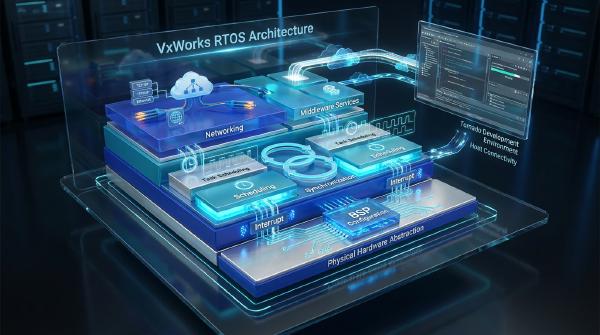
The Siemens SIMATIC IPC VxWorks environment is best understood as a layered platform rather than a single software component.
At the lowest level is the physical SIMATIC IPC hardware.
Above that sits the Siemens-specific BSP and Support Package, which exposes platform-specific devices and industrial interfaces.
VxWorks then provides the deterministic real-time operating environment.
Wind River Workbench supplies the development tooling required to configure, build, debug, and deploy the software.
Finally, customer applications implement the actual industrial control or processing logic.
The complete stack can be summarized as:
SIMATIC IPC Hardware
↓
Siemens VxWorks BSP / Support Package
↓
VxWorks Runtime System
↓
Kernel Services / RTP Environment
↓
Customer Application
↓
Industrial Process
This layered approach separates hardware integration from operating-system services and application logic.
🔭 Building Customer-Specific VxWorks Applications #
The SIMATIC IPC Support Package for VxWorks provides the missing platform-specific layer required to use Siemens industrial hardware effectively within a VxWorks-based system.
Its support for PROFIBUS, PROFINET, hardware-dependent functions, drivers, application examples, online help, and code completion reduces the amount of low-level integration work required from developers.
The supported Wind River environments provide two major development paths: VxWorks 6.9 with Workbench 3.3 for legacy 32-bit deployments and VxWorks 7 with Workbench 4 for newer supported configurations.
For industrial developers, the key advantage is the combination of three capabilities in one platform:
Deterministic VxWorks execution + Siemens hardware integration + industrial network connectivity
This architecture makes it possible to build customer-specific real-time applications that directly leverage SIMATIC IPC hardware while retaining the predictable execution model required by industrial systems.
The most important engineering task is ensuring that the SIMATIC IPC model, BSP/support-package release, VxWorks runtime, and Workbench version are correctly aligned before beginning application development. Once that foundation is established, PROFIBUS, PROFINET, and hardware-specific capabilities can be integrated into the customer application without rebuilding the entire hardware-support stack from scratch.