VxWorks CPCI Multi-Channel Card Driver: Design and Implementation
Large-scale offshore towed-streamer seismic exploration places demanding requirements on real-time data acquisition, multi-channel processing, and system responsiveness. The control system must coordinate multiple hardware channels while processing incoming data within strict timing constraints. General-purpose operating systems may not provide the scheduling predictability and interrupt-response characteristics required by these workloads without additional real-time mechanisms.
To address these requirements, researchers from the Geophysical Department of China Oilfield Services Limited designed and implemented a CompactPCI (CPCI) multi-channel card driver based on the VxWorks real-time operating system (RTOS). The driver operates in a CPCI industrial control chassis and was integrated into the Haiyan streamer positioning and control system.
The reported implementation supports 12-channel data processing and has been used in offshore seismic survey operations. Its design focuses on three core areas: PCI device memory mapping, interrupt registration and initialization, and interrupt service routine (ISR) processing.
This article examines the driver architecture, explains the key implementation considerations, and shows how separating interrupt handling from data processing helps achieve responsive, maintainable real-time acquisition software.
🏗️ System Architecture #
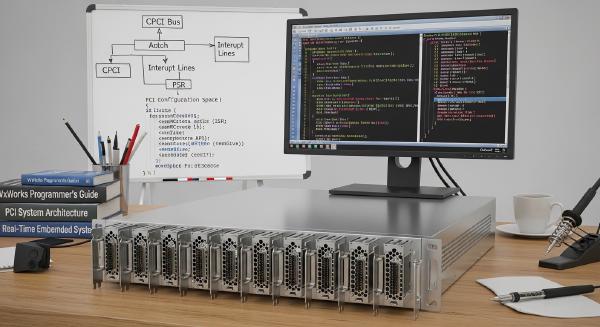
The CPCI multi-channel acquisition system consists of an industrial control chassis, multiple multi-channel interface cards, and VxWorks as the real-time operating system. The cards use the PLX PCI9054 bridge chip to provide PCI connectivity between the host system and device-specific logic.
Hardware Architecture #
The principal hardware components are:
- CPCI industrial control chassis: Provides the embedded computing platform and CPCI backplane.
- Multi-channel interface cards: Handle the hardware interfaces and data paths required by the acquisition system.
- PCI9054 bridge chip: Connects the card’s device-specific logic and memory resources to the host PCI bus.
- VxWorks target platform: Executes the driver, handles hardware interrupts, and coordinates application-level data processing.
The PCI9054 provides the host interface, while the exact register layout, memory resources, and interrupt behavior depend on the card’s hardware implementation.
Software Architecture #
The software follows a layered VxWorks architecture. The Board Support Package (BSP) provides platform-level hardware initialization and services, the device driver manages card-specific operations, and the application layer consumes the functionality exposed by the driver.
The driver is organized into three primary modules:
- Memory mapping: Discovers the PCI device and maps its required hardware resources into the processor’s address space.
- Interrupt registration and initialization: Configures interrupt routing and enables the appropriate device interrupt sources.
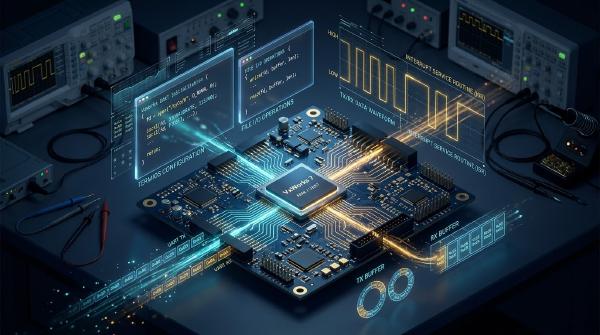
- Interrupt service routine processing: Acknowledges hardware events and notifies a dedicated task when data is ready.
This modular structure separates hardware access from application logic and makes the driver easier to maintain and adapt to related acquisition platforms.
🧠 PCI Device Discovery and Memory Mapping #
PCI devices expose their addressable resources through Base Address Registers (BARs) in PCI configuration space. Depending on the hardware design, these BARs may describe memory-mapped I/O regions or I/O-port resources.
For the CPCI multi-channel card, the driver identifies the PCI9054-based device, determines the relevant memory resources, and maps those resources for use by the driver.
Locate the PCI Device #
The first step is to identify the target device through its PCI Vendor ID and Device ID.
In VxWorks environments that provide the relevant PCI library interfaces, pciFindDevice() can locate a matching device. The returned bus, device, and function information is then used to access the device’s PCI configuration registers.
The driver can use pciConfigInLong() to read a 32-bit configuration register, including a BAR or other required configuration field.
Device discovery should also account for systems containing multiple instances of the same card. Where necessary, the driver must select the intended device instance rather than assuming that the first matching device is always the correct one.
Determine the BAR Size #
The driver must determine the address range occupied by the hardware resource before establishing the mapping.
A conventional PCI BAR-sizing procedure involves the following operations:
- Save the original BAR value.
- Ensure that the relevant device decoding is disabled when required by the platform and device specification.
- Write all ones to the BAR and read back the implemented address mask.
- Calculate the resource size from the mask, accounting for the BAR type and its address attributes.
- Restore the original BAR value and restore the device configuration as appropriate.
The resource-size calculation must follow the PCI specification and the device’s BAR format. Memory BARs and I/O BARs are not interchangeable, and 64-bit memory BARs require special handling.
The original design identifies BAR2 as the typical resource of interest. However, the correct BAR depends on the specific card implementation and must be verified against its PCI configuration and hardware documentation.
Align the Mapping Size #
VxWorks memory management operates on page-based mappings. If a PCI resource does not begin and end on page boundaries, the mapping range may need to be expanded to cover the complete resource.
The driver should calculate the page-aligned mapping range using the platform’s page-size definition, such as VM_PAGE_SIZE, where available.
Care is required to preserve the original resource offset within the mapped region. The mapped virtual address used by the driver must correspond correctly to the device’s physical address, including any alignment adjustment.
Map the Hardware Resource #
After determining the physical resource range, the driver establishes a mapping into the processor’s virtual address space.
In environments that support it, sysMmuMapAdd() can be used as part of the platform-specific memory-mapping procedure. The precise API and required mapping attributes depend on the VxWorks version, processor architecture, BSP, and MMU configuration.
PCI device registers and shared device memory generally require memory attributes suitable for device access. Cacheability, ordering, and access permissions must be configured according to the processor and device specifications; using ordinary cached-memory settings without verification can introduce stale data or incorrect register-access behavior.
Once the mapping is established, the driver can access the required device registers and dual-port memory through the mapped virtual address range.
This approach provides a consistent address-space interface between the hardware and software while preserving the memory-access semantics required for reliable data acquisition.
⚡ Interrupt Registration and Initialization #
Interrupt handling is central to a real-time acquisition driver. The system must detect hardware events quickly, identify the appropriate interrupt source, and transfer execution to the driver without introducing unnecessary latency.
The initialization module configures the relationship between the PCI device’s interrupt output and the VxWorks interrupt-handling infrastructure.
Retrieve and Configure the Interrupt #
The interrupt initialization process typically includes these operations:
- Read the assigned interrupt information from the PCI configuration space.
- Determine the platform-specific interrupt vector or routing information.
- Register the driver’s ISR through an appropriate VxWorks interrupt connection interface.
- Configure the PCI9054 Interrupt Control/Status Register (INTCSR) for the required interrupt sources.
- Enable the associated interrupt in the platform’s interrupt controller.
The original design identifies pciIntConnect() and intConnect() as possible ISR registration interfaces. The appropriate choice depends on the VxWorks release, BSP, and hardware interrupt-routing model.
Where supported and appropriate, pciIntConnect() can simplify registration for PCI interrupts, including devices that share an interrupt line. The handler must still determine whether the interrupt belongs to its device before acknowledging or processing it.
The final enablement sequence should follow the PCI9054 documentation and the target platform’s interrupt-controller requirements. Interrupt sources should be configured and cleared in the correct order to avoid losing events during initialization.
Configure the PCI9054 Interrupt Registers #
The PCI9054 INTCSR controls relevant interrupt sources and reports interrupt-related status. The driver must configure the required interrupt enables and interpret the resulting status correctly.
Interrupt initialization should ensure that:
- Only intended interrupt sources are enabled.
- Pending status is handled according to the device’s register semantics.
- Device-level interrupt configuration is consistent with the host interrupt-routing configuration.
- The interrupt controller is enabled only after the handler and required driver state are ready.
Some hardware status registers use write-one-to-clear semantics or have other device-specific acknowledgement rules. The driver must follow the PCI9054 documentation rather than applying a generic clear operation to every status register.
Correct initialization prevents spurious interrupts, missed events, and interrupt storms that can degrade the responsiveness of the entire real-time system.
🚀 Design a Low-Latency Interrupt Service Routine #
The ISR is the entry point for handling hardware interrupts. Because it executes in an interrupt context, its workload should be kept minimal and bounded.
Performing extensive data processing directly inside the ISR can increase interrupt latency, delay other interrupt handlers, and make system response times less predictable.
The CPCI driver therefore separates hardware-event handling from application-level processing.
ISR Processing Sequence #
The ISR follows a short sequence:
- Inspect the interrupt status: Read the PCI9054 INTCSR or relevant status registers to determine whether the interrupt originated from a supported source.
- Acknowledge the event: Clear or acknowledge the interrupt using the documented device-specific procedure.
- Notify the processing task: Use
semGive()to release a binary semaphore that signals the availability of data or a hardware event. - Return promptly: Exit the ISR without carrying out extensive data processing.
If the device shares an interrupt line with other PCI devices, the ISR must first verify that its own device generated the interrupt. It should avoid acknowledging interrupts belonging to unrelated devices.
The exact acknowledgement and notification ordering depends on the device’s interrupt semantics. The implementation must ensure that a new event cannot be lost between status acknowledgement and task notification.
Defer Data Processing to a Dedicated Task #
The driver creates a dedicated, appropriately prioritized task that waits for the binary semaphore. When the ISR signals the semaphore, the task resumes and performs the more expensive processing operations.
The division of responsibility is straightforward:
- ISR: Detects and acknowledges the hardware event, then signals the task.
- Processing task: Reads or processes acquisition data, updates software state, and performs other operations that do not belong in interrupt context.
- Application layer: Consumes the resulting data or invokes the driver’s higher-level services.
This deferred-processing design offers several advantages.
Reduced interrupt duration: The ISR performs only the operations needed to service and acknowledge the hardware event.
Improved system responsiveness: Other interrupts and time-critical tasks are less likely to be delayed by lengthy acquisition processing.
Cleaner software structure: Hardware event handling is separated from data-processing logic, making the implementation easier to test and maintain.
Better control over scheduling: The processing task can be assigned a priority based on acquisition deadlines and the workload of other real-time tasks.
A binary semaphore may coalesce repeated notifications if the processing task does not run between events. Therefore, it should be used only when the driver can safely recover the complete set of pending work from device status, hardware buffers, counters, or another event-tracking mechanism. If every interrupt represents a distinct item that must be preserved, a counting semaphore, queue, ring buffer, or equivalent mechanism may be more appropriate.
The design must also consider buffer ownership, data overrun detection, synchronization, and the possibility that a new event arrives while the task is still processing an earlier one.
📡 Application Results and Field Deployment #
The completed CPCI multi-channel driver was integrated into the Haiyan streamer positioning and control system used in offshore seismic exploration.
According to the reported implementation, the system supports 12 independent channels and has been deployed in multiple offshore seismic survey operations. The reported field experience indicates that the driver met the real-time responsiveness and processing-efficiency requirements of the intended application.
The design’s principal contribution is the combination of direct hardware resource access, structured interrupt initialization, and deferred task-level processing. These mechanisms allow the software to respond promptly to hardware events while keeping more expensive operations outside the ISR.
A complete quantitative evaluation would additionally report measurements such as interrupt-to-task response time, data throughput per channel, worst-case processing latency, buffer overrun rates, CPU utilization, and behavior under simultaneous channel activity. Such measurements would make it easier to assess timing margins and compare performance across hardware configurations.
🔧 Reliability and Portability Considerations #
Although the implementation targets a particular CPCI acquisition system, its architecture can be applied to other embedded devices that need low-latency interrupt handling and multi-channel data processing.
Several engineering considerations are important when adapting the design.
Hardware and BSP Compatibility #
PCI discovery, interrupt routing, MMU mappings, and device-register access are affected by the BSP and processor architecture. APIs and configuration procedures that work on one VxWorks target may require changes on another.
The driver should isolate platform-dependent operations so that the device-specific logic remains separate from BSP-specific initialization and interrupt configuration.
Interrupt and Shared-State Synchronization #
The ISR and processing task may access related device state. Shared data structures must be protected using synchronization mechanisms appropriate to each execution context.
An ISR should not block on a semaphore or acquire a synchronization primitive that can sleep. Use ISR-safe APIs and avoid any operation that could cause unbounded waiting in interrupt context.
Data Integrity and Buffer Management #
High-rate acquisition systems must handle the possibility that data arrive faster than the processing task can consume them. Ring buffers, producer-consumer indices, hardware status counters, and explicit overrun detection can help preserve data integrity.
The system should define what happens when buffers fill, a channel reports an error, or the processing task falls behind. These conditions are important for ensuring predictable behavior during extended field operations.
Timing Verification #
Average latency alone does not establish that a real-time driver meets its deadlines. Testing should include peak channel activity, concurrent interrupts, prolonged operation, error conditions, and representative application workloads.
Where timing guarantees are required, the evaluation should include worst-case response behavior and sufficient margin for scheduling interference, interrupt contention, and data-processing variation.
✅ Conclusion #
The VxWorks-based CPCI multi-channel card driver demonstrates a practical architecture for real-time data acquisition in offshore seismic control systems. Its implementation combines PCI device discovery, memory-resource mapping, interrupt registration, PCI9054 status handling, and semaphore-driven deferred processing.
Keeping the ISR short reduces the time spent in interrupt context, while a dedicated task handles data processing under the VxWorks scheduler. This separation supports responsive interrupt handling, clearer software modularity, and more manageable task-level processing.
Integrated into the Haiyan streamer positioning and control system, the reported implementation supports 12-channel data processing and has been used in offshore seismic survey operations.
The same principles can guide other embedded multi-channel acquisition drivers. Reliable results, however, depend on correct PCI resource mapping, device-specific interrupt handling, safe synchronization, robust buffer management, and measurements that demonstrate the system’s timing behavior under realistic worst-case workloads.