Wind River Tilcon Adds OpenGL 3D Graphics for Embedded GUIs
Wind River, a wholly owned subsidiary of Intel, introduced a new version of the Wind River Tilcon Graphics Suite with support for 3D OpenGL (Open Graphics Library), extending its embedded GUI development capabilities to increasingly sophisticated visualization and control applications.
Tilcon is designed for embedded device manufacturers that need highly customized graphical interfaces without building the entire graphics stack from scratch. The new OpenGL capability targets demanding applications in aerospace and defense, industrial control, medical devices, transportation, and other embedded markets where responsive, graphics-rich user interfaces are becoming an important part of the product architecture.
By combining a visual development environment with a reusable GUI engine and OpenGL-based graphics acceleration, the suite aims to reduce GUI development effort while enabling richer interfaces across multiple hardware and operating-system configurations.
🎨 3D OpenGL Support for Embedded Interfaces #
The addition of 3D OpenGL provides Tilcon with a standardized graphics API for developing more sophisticated embedded interfaces.
Rather than limiting applications to conventional 2D widgets and static graphics, developers can use OpenGL-based rendering capabilities to build interfaces with richer visual effects and more complex graphical content.
Target applications include:
- Medical monitoring equipment
- Clinical and surgical system interfaces
- Railway operation and control panels
- Retail terminal interfaces
- Industrial control systems
- Aerospace and defense equipment
These applications often combine real-time system information with graphical visualization, requiring the GUI layer to remain responsive while presenting increasingly complex information to operators.
Graphics requirements in embedded systems #
Embedded GUI workloads differ from desktop applications because the graphics subsystem must operate within constrained CPU, memory, storage, and power budgets.
OpenGL provides a vendor-neutral graphics programming model that can take advantage of available hardware acceleration while allowing the application-level graphics code to remain relatively independent of the underlying GPU implementation.
For embedded products, this separation can simplify portability across supported processor and graphics platforms.
🛠️ Tilcon Development Environment #
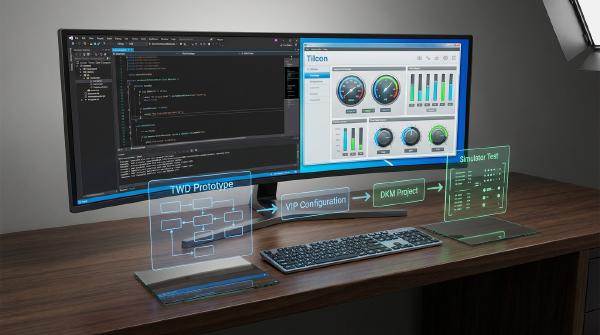
The Wind River Tilcon Interface Development Tool provides a visual environment for constructing embedded user interfaces.
Its drag-and-drop workflow allows developers to assemble interface components and rapidly create complete GUI applications without manually implementing every low-level graphics operation.
The approach is intended to reduce both development time and the engineering effort associated with maintaining custom graphics code.
Wind River Tilcon GUI Engine #
At the center of the Tilcon architecture is the Wind River Tilcon GUI Engine, which abstracts many of the implementation details required by an embedded graphical interface.
The engine manages core GUI resources and rendering-related elements, including:
- Graphics primitives
- Fonts
- Text
- Images
- Colors
- Interface components
- Underlying graphics code
This architecture allows application developers to focus more heavily on interface behavior and product-specific functionality rather than repeatedly implementing low-level GUI infrastructure.
Visual development workflow #
The Interface Development Tool provides a graphical authoring model that can accelerate common development activities:
GUI Design
    |
    v
Tilcon Interface Development Tool
    |
    v
Tilcon GUI Engine
    |
    +-------------------+
    |                   |
    v                   v
Graphics / Rendering   Fonts / Text / Images
    |
    v
OpenGL / Platform Graphics Layer
    |
    v
Embedded Hardware
The separation between visual design, GUI services, and the underlying graphics implementation also makes the architecture more suitable for maintaining interfaces across multiple embedded product generations.
💻 Operating System Support #
The Tilcon Graphics Suite supports both Wind River operating systems and several third-party operating environments.
Wind River operating systems #
The suite supports current versions of:
- VxWorks
- Wind River Linux
This combination covers both real-time embedded systems and Linux-based embedded platforms.
VxWorks is particularly relevant for deterministic embedded applications such as industrial control, aerospace, transportation, and other systems with real-time requirements.
Third-party operating systems #
The announced platform support also includes:
- Windows CE
- Windows XP
- Fedora
- Red Hat Enterprise Linux
- Ubuntu
Supporting multiple operating systems allows organizations to reuse development concepts and GUI assets across different embedded product architectures.
🧩 Hardware Platform Support #
The release expanded hardware coverage to include several processor and embedded computing platforms:
- Freescale i.MX31
- Intel Atom processors
- Texas Instruments OMAP platforms
These platforms represented important embedded processing architectures for graphics-enabled devices, particularly where a product required a combination of application processing and hardware-accelerated graphics.
OpenGL’s standardized programming model also helps separate higher-level GUI development from the implementation details of individual graphics processors.
🌐 OpenGL as a Cross-Platform Graphics Layer #
OpenGL is an open and vendor-neutral graphics standard designed to provide a consistent programming interface across different graphics implementations.
For embedded GUI development, this abstraction can be valuable because the application should not need to directly depend on the low-level details of every supported GPU.
A simplified architecture is:
Application GUI
      |
      v
Tilcon GUI Engine
      |
      v
OpenGL API
      |
      v
Platform Graphics Driver
      |
      v
GPU / Graphics Hardware
The underlying graphics driver remains responsible for translating OpenGL operations into hardware-specific commands.
This architecture provides a clearer separation between GUI application logic and platform-specific graphics implementation, which can improve portability when deploying similar interfaces across different embedded hardware.
🚀 Accelerating Embedded GUI Development #
One of Tilcon’s primary objectives is reducing the engineering effort required to develop and maintain sophisticated embedded interfaces.
Traditional embedded GUI development can require substantial manual work across several layers:
- User-interface design
- Widget implementation
- Graphics rendering
- Font and text handling
- Image management
- Input processing
- Platform integration
- Hardware-specific graphics acceleration
Tilcon centralizes many of these responsibilities within its development tools and GUI engine.
The visual development workflow further reduces the amount of handwritten GUI implementation required for common interface components, potentially shortening development cycles and helping manufacturers bring graphics-intensive products to market faster.
✈️ Industry Applications #
The expanded graphics capabilities are particularly relevant to industries where the GUI is part of the operator’s primary interaction with the embedded system.
Aerospace and defense #
Aerospace and defense systems can require dense displays containing status information, navigation data, system diagnostics, and other operational information.
A graphics framework with OpenGL support provides a foundation for implementing richer visualization while retaining the deterministic characteristics required by embedded operating environments such as VxWorks.
Industrial control #
Industrial control systems increasingly rely on graphical operator interfaces rather than simple text-based or static control panels.
OpenGL-enabled graphics can support more sophisticated visualization of machine states, process information, alarms, and system diagnostics.
Medical devices #
Medical equipment requires interfaces that can present complex information clearly and efficiently.
Applications such as patient monitoring systems and clinical equipment can benefit from graphical rendering capabilities while retaining a controlled embedded software architecture.
Transportation #
Railway control panels and other transportation systems require operators to interpret large amounts of system information quickly.
Rich graphical interfaces can provide more effective visualization of operational state, equipment status, alarms, and control functions.
🗣️ Wind River’s Industry Position #
Wind River positioned the OpenGL enhancement as a response to the growing complexity of embedded graphical interfaces.
The company’s product strategy emphasized the need for graphics frameworks that could help embedded developers create sophisticated user experiences without assuming the development model of a desktop operating system.
This was particularly important in vertical markets such as aerospace and defense, industrial control, and medical imaging, where the GUI is closely integrated with specialized hardware and operating-system requirements.
🖥️ Wind River Hypervisor Adds Windows XP Guest Support #
Alongside the Tilcon Graphics Suite update, Wind River announced additional functionality for the Wind River Hypervisor.
The update enabled Windows XP to run concurrently as a guest operating system alongside other operating systems, including VxWorks.
A hypervisor-based architecture allows multiple operating environments to share a single hardware platform while maintaining separation between guest operating systems.
A simplified configuration can be represented as:
+--------------------------------------+
|        Embedded Applications         |
+------------------+-------------------+
|      VxWorks     |     Windows XP    |
|      Guest       |       Guest       |
+------------------+-------------------+
|          Wind River Hypervisor       |
+--------------------------------------+
|          Embedded Hardware           |
+--------------------------------------+
This capability can be useful for systems that need to consolidate different software environments onto a single processor platform.
For example, a product could use VxWorks for real-time control functions while hosting an existing Windows-based application that depends on Windows XP compatibility.
🔍 Architectural Significance #
The combination of Tilcon’s OpenGL support and Wind River Hypervisor’s expanded guest operating-system capabilities reflects a broader trend in embedded computing: increasingly sophisticated application requirements are being combined with specialized real-time and hardware constraints.
From the graphics perspective, Tilcon provides an abstraction layer between GUI development and platform-specific rendering implementations.
From the virtualization perspective, Wind River Hypervisor provides isolation between different operating environments running on the same hardware.
Together, these technologies address two different layers of embedded-system complexity:
| Layer | Technology | Primary Role |
|---|---|---|
| GUI development | Tilcon Interface Development Tool | Visual interface design |
| GUI runtime | Tilcon GUI Engine | Rendering and interface management |
| Graphics API | OpenGL | Standardized graphics interface |
| Operating system | VxWorks / Wind River Linux | Embedded runtime environment |
| Virtualization | Wind River Hypervisor | Multi-OS execution and isolation |
| Hardware | i.MX31 / Intel Atom / OMAP | Target processing platform |
📌 Summary #
The updated Wind River Tilcon Graphics Suite introduced 3D OpenGL support to Wind River’s embedded GUI development platform, extending its capabilities for graphics-intensive applications in aerospace, defense, industrial control, medical, transportation, and retail systems.
The combination of the Tilcon Interface Development Tool and Tilcon GUI Engine provides a higher-level development model for creating customized embedded interfaces, while OpenGL supplies a standardized graphics layer capable of supporting hardware-accelerated rendering.
The release also expanded platform coverage across VxWorks, Wind River Linux, several third-party operating systems, and embedded hardware platforms including Freescale i.MX31, Intel Atom, and TI OMAP.
At the same time, the Wind River Hypervisor update added Windows XP guest support, enabling Windows XP to run concurrently with operating systems such as VxWorks. Together, these capabilities strengthened Wind River’s platform for developing graphics-rich, multi-OS embedded systems.